Lasers And Lights

Laser and Light Treatments for Skin and Hair at Cutis Hospital

Laser and light treatments use focused beams of light to treat skin and hair problems. At Cutis Hospital, dermatologists use them for unwanted hair, dark spots, melasma, acne scars, tattoos, ageing skin and some hair and skin diseases. Treatments are offered at our Vijayanagar, HSR Layout and Kochi branches.

What are laser and light treatments?

Laser and light treatments are medical procedures that send controlled light energy into the skin. Each device uses a set type of light. The light is taken up by a target, such as hair roots, dark pigment or water in the skin. This heats and breaks down the target, while the skin around it is protected.
There are two main groups:

Which skin and hair problems can lasers treat?

Lasers can treat many common skin and hair problems. These include unwanted hair, dark spots, melasma, tanning, acne scars, open pores, fine lines, tattoos, and some birthmarks. Light therapy can also help psoriasis, vitiligo, and hair thinning. A dermatologist must first check if a laser is right for your skin and condition.
There are two main groups:
ProblemLaser or light option at Cutis
Unwanted hairLaser hair reduction
Dark spots, melasma, tanningLaser toning, Ruvy Touch, Gold Toning
Dull skin, oily skin, open poresCarbon laser peel (Hollywood peel), Shining Peel
Acne scars, fine lines, rough textureFractional CO2 (DOT) laser
TattoosLaser tattoo removal
Hair thinningLow-level laser therapy (LLLT)
Psoriasis, vitiligoPhototherapy (NB-UVB), excimer light [Add: confirm branches offering phototherapy]
Dark lipsLip toning

What laser and light treatments are available at Cutis?

Cutis offers laser hair reduction, laser toning, carbon laser peel, fractional CO2 laser, tattoo removal, low-level laser therapy for hair and phototherapy for skin diseases. Your dermatologist picks the device and settings based on your skin type, your problem, and your health. Not every device may be available at every branch.

Laser hair reduction

Reduces unwanted hair on the face and body. The laser targets the dark pigment in the hair root. Several sessions are needed because hair grows in cycles.

Laser toning, Ruvy Touch and Gold Toning

Gentle pigment lasers that lighten dark spots, melasma and tan. They work slowly over many sessions with little or no downtime.

Carbon laser peel

A thin carbon layer is put on the skin and then cleared with a laser. It helps oily skin, open pores and dullness.

Fractional CO2 (DOT) laser

Makes tiny, controlled spots of heat in the skin. This helps the skin make new collagen. It is used for acne scars, other scars and rough skin.

Laser tattoo removal

Breaks tattoo ink into tiny pieces that the body clears over time. Many sessions are usually needed. Some colours fade more easily than others.

Low-level laser therapy (LLLT) for hair

Uses low-energy red light to support hair growth. It is often combined with other hair-loss treatments.

Phototherapy for psoriasis and vitiligo

Controlled exposure to special UV light that calms the skin’s immune response. It is given two to three times a week for some weeks, under a doctor’s care. [Add: confirm which branches offer phototherapy]

How does laser treatment work at Cutis?

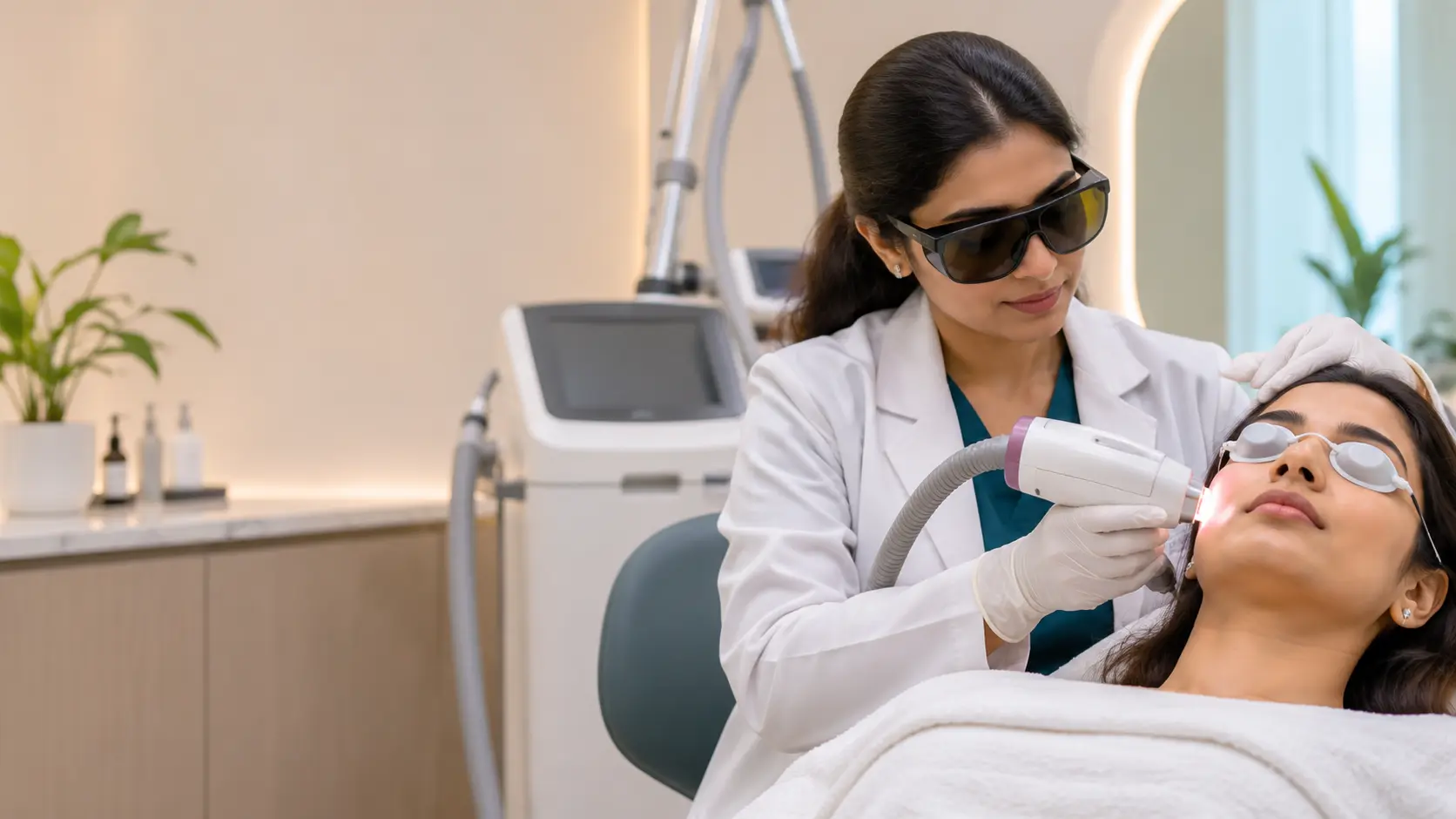
Every laser treatment at Cutis starts with a consultation with a dermatologist. The doctor checks your skin type and the problem, then plans the right laser and number of sessions. A small test spot may be done first. Each session is short. Most people can return to normal work soon after.

What are the benefits of laser treatment?

Laser treatment is precise. It targets the problem area and protects the skin around it. Most laser sessions are quick, need no cuts or stitches, and have short recovery. Results build up over a series of sessions. Many laser treatments can be combined with creams, peels or other care for better results.

Are lasers safe for Indian skin?

Yes, lasers can be safe for Indian skin when a trained dermatologist chooses the right device and settings. Brown skin has more pigment, so it has a higher risk of dark or light patches if the wrong settings are used. That is why a skin check, test patch and sun protection are important before and after treatment.

Laser toning, Ruvy Touch and Gold Toning

Less common risks:

Who should wait or avoid lasers: People with an active skin infection, a recent tan, certain light-sensitive conditions or those taking some acne medicines (like isotretinoin). Tell your doctor if you are pregnant. Your dermatologist will advise you.

How should you care for your skin after laser treatment?

After laser treatment, keep the skin clean, cool, and protected from the sun. Use the cream your doctor gives you and apply sunscreen every day. Do not scrub, pick or peel the treated skin. Avoid heat, steam, swimming and strong skincare products for a few days, or as your doctor advises.

Why choose Cutis for laser and light treatments?

At Cutis, every laser treatment is planned by a dermatologist, not a beautician. Our doctors look at your skin type and the cause of your problem before they choose a laser. Cutis is also a teaching hospital for dermatology, and our aesthetic team has a special interest in pigment lasers and skin rejuvenation.

Where can you get laser treatment at Cutis?

You can get laser and light treatments at Cutis Hospital in Vijayanagar, Bangalore, at the HSR Layout clinic in Bangalore, and at the Kaloor clinic in Kochi. Please call ahead to check which laser is available at your chosen branch and to book a consultation.

Key facts: laser and light treatments

Book a laser consultation

Not sure which laser is right for you? Meet a Cutis dermatologist first. Call 080 2340 1200 (Vijayanagar) or 089708 22333 (HSR Layout), or book online.

Frequently Ask Question

Laser hair reduction gives a long-lasting drop in hair growth, but it is not always 100% permanent. Some fine hair may regrow. A few top-up sessions may be needed over time.
Most people feel a quick snap or warm feeling, like a rubber band. A numbing cream or cooling device is used to keep you comfortable.
It depends on the problem and the laser. Hair reduction and pigment treatments usually need a series of sessions spaced a few weeks apart. Your dermatologist will give you a plan.
Yes, when a dermatologist picks the right laser and settings. Darker skin has a higher risk of pigment changes, so test patches and strict sun protection are important.
Lasers can make acne scars much less visible, but they rarely remove them fully. Deep scars may need a mix of lasers, peels or minor skin surgery.
After most gentle lasers, yes. After stronger lasers like fractional CO2, you may have redness or small scabs for a few days. Plan your time off with your doctor.
People with an active skin infection, a fresh tan or certain light-sensitive conditions should wait. Tell your doctor about all medicines, and if you are pregnant.
The cost depends on the type of laser, the area treated and the number of sessions. Your dermatologist will share the cost at your consultation. [Add: price range if Cutis wants to publish it]