Different tattoo ink colours require specific laser wavelengths for optimal removal:
• Black and Blue Tattoos: Best treated with Q-switched ruby laser (694 nm), Q
switched Nd:YAG laser (1064 nm), or Q-switched alexandrite laser (755 nm).
o The 1064 nm Nd:YAG is particularly preferred as it penetrates deeper into
skin and has minimal absorption by epidermal melanin, reducing risk of
pigmentary complications.
• Red, Orange, and Yellow Tattoos: Require shorter wavelengths like 532 nm
(frequency-doubled Nd:YAG) or green laser wavelengths.
• Green Tattoos: Treated with 755 nm alexandrite or ruby laser wavelengths.
• Multicoloured Tattoos: Often require combination laser treatments using multiple
wavelengths to address each ink colour.
At Cutis Hospital, dermatologists select the appropriate laser based on your tattoo’s colour
profile, ink density, skin tone, and previous treatment history.
Several factors determine how quickly and completely a tattoo can be removed:
• Tattoo Age: Older tattoos with faded ink remove faster than fresh tattoos with dense
pigment.
• Ink Colour and Type: Professional black/blue ink is predictable; some amateur or
coloured inks are more resistant and require more sessions.
• Tattoo Size and Density: Large tattoos with thick, saturated ink require more
sessions than small, light tattoos.
• Skin Tone: Fair skin typically shows faster clearing. Darker skin types require
careful wavelength selection (longer wavelengths preferred) to avoid
hyperpigmentation or hypopigmentation.
• Location: Tattoos on areas with good circulation (face, neck) remove faster than
those on extremities with poor blood flow (hands, feet, lower legs).
• Previous Treatments: Professional tattoos remove faster than amateur (home
made) tattoos.
Your dermatologist will assess these factors to provide realistic expectations about the
number of sessions needed.
Professional tattoo removal at Cutis is a controlled, well-tolerated procedure:
1. Pre-Treatment Consultation: Your dermatologist examines the tattoo, determines its
pigment composition, evaluates skin tone, and discusses expected results and
timeline.
2. Spot Test (Optional): A small test spot may be treated first to assess skin response
and expected clearance rate.
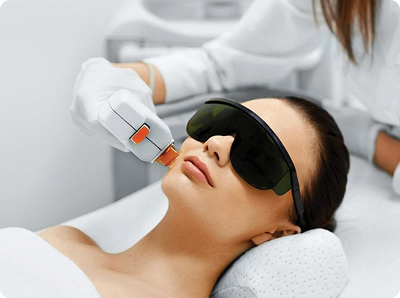
3. Eye Protection: Protective eyewear is provided to both patient and staff.
4. Numbing: A topical numbing cream or local anesthetic is applied 20–30 minutes
before treatment.
5. Laser Application: The Q-switched laser is carefully aimed at the tattoo in short,
precise pulses. Spot sizes of 3–4 mm are typically used, with 10–20% overlap
between pulses.
6. Endpoint: The dermatologist watches for immediate tissue whitening (frosting
effect), which indicates successful pigment fragmentation.
7. Post-Treatment Care: A topical antibiotic ointment is applied; the area is bandaged;
you receive detailed aftercare instructions.
Session duration depends on tattoo size, typically ranging from 10 minutes to 1 hour.
Expected Clearance:
• Professional tattoos typically require 6–8 sessions for 75–95% clearance.
• Amateur tattoos may clear in 3–6 sessions due to looser, less-stable pigment.
• Some tattoos achieve complete clearance; others may show slight residual shadow,
depending on ink type and density.
Session Spacing:
• Treatments are spaced 6–8 weeks apart to allow the body time to eliminate
fragmented pigment through the lymphatic system.
Results Per Session:
• Visible fading typically becomes apparent within 2–4 weeks of the first session.
• With each subsequent session, tattoo pigment progressively reduces.
Post-Treatment Expectations:
• Mild redness, swelling, and tenderness immediately after treatment, typically
resolving within 24–48 hours.
• A frosted or white appearance on the treated area immediately post-treatment,
fading within hours.
• Possible blistering or crusting in the first few days; this is normal and should not be
picked.
• Strict sun protection (SPF 50+) is essential to prevent complications and
hyperpigmentation.
Realistic Expectations:
• Complete tattoo removal is possible for most tattoos but may require patience and
multiple sessions.
• Treatment success depends on close adherence to aftercare instructions and sun
protection.
Expected Clearance:
• Professional tattoos typically require 6–8 sessions for 75–95% clearance.
• Amateur tattoos may clear in 3–6 sessions due to looser, less-stable pigment.
• Some tattoos achieve complete clearance; others may show slight residual shadow,
depending on ink type and density.
Session Spacing:
• Treatments are spaced 6–8 weeks apart to allow the body time to eliminate
fragmented pigment through the lymphatic system.
Results Per Session:
• Visible fading typically becomes apparent within 2–4 weeks of the first session.
• With each subsequent session, tattoo pigment progressively reduces.
Post-Treatment Expectations:
• Mild redness, swelling, and tenderness immediately after treatment, typically
resolving within 24–48 hours.
• A frosted or white appearance on the treated area immediately post-treatment,
fading within hours.
• Possible blistering or crusting in the first few days; this is normal and should not be
picked.
• Strict sun protection (SPF 50+) is essential to prevent complications and
hyperpigmentation.
Realistic Expectations:
• Complete tattoo removal is possible for most tattoos but may require patience and
multiple sessions.
• Treatment success depends on close adherence to aftercare instructions and sun
protection.